By Christina Georgiou
 |
| Click on any photo to see it full size. |
There are three organizations—Easton Main Street, the Easton Ambassadors, and the Easton Farmers' Market—that Mayor Sal Panto says he credits with attracting and increasing development in the city's Downtown.
"These three organizations—without them we'd revert 20 years,” he told a group of about 50 people gathered at Nurture Nature Center for the Greater Easton Development Partnership (GEDP) annual meeting Thursday evening.
Panto estimated there is currently $320 million worth of development projects currently taking place in the city, and said that revenue related to business has been steadily rising. He added the city currently sees $1.2 million annually in revenue from taxes and user fees, an amount he expects to rise by another $220,000 when Crayola completes its expansion.
“Neighborhoods will always be the lifeblood of the city, but Downtown is (where the money comes from),” the mayor said. “It's happening. And those that don't believe that, let them go. Because we don't need them.”

GEDP is the overseeing organization for all three, and while it's not a part of the Easton's government, it also works closely with the city's Redevelopment Authority. Gretchen Longenbach, a city employee, is the Authority's director and also the executive director for the GEDP.

She explained some of the relationship between the city's Redevelopment Authority and GEDP.


"When the Redevelopment Authority...loans funds to the developer...the funds are granted on repayment to GEDP,” Longenbach said, adding that some of that money is used to fund the Main Street and Ambassadors programs.

“We are attempting to not be as reliant on city funds,” she said.

Annually, the GEDP budget includes:
GEDP administration $35,000
Main Street Initiative $250,000
Easton Farmers' Market $100,000
Ambassadors $240,000
“While it's a large sum of money, in the scheme of what it can accomplish, it's actually a small sum of money,” Longenbach said.
Each of the three organizations the GEDP oversees also gave individual presentations on their efforts
The Easton Farmers' Market

EFM manager, Megan McBride, who is also the assistant director for the Easton Main Street Initiative, said that the market has been growing steadily since it came under GEDP management three years ago. She added the move was necessary.

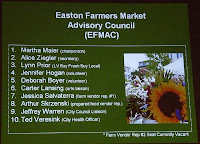
“We needed more administration and bookkeeping,” she said.

On top of vendor efforts, about 75 people volunteer their time to promote and staff the market, along with more than a dozen commercial sponsors, McBride estimated.
“We couldn't do it without our sponsors and partners,” she said.

Signs of the market's growth and success include recognition from the USDA and the Mid-Atlantic Fruit and Vegetable Marketers'Association, as well as an increase in the average dollars per sale and weekly attendance, McBride said.

“Originally, we had to go far and wide to find vendors,” she told
attendees Thursday evening. “That's no longer the case. We have a waiting list.”
Challenges still face the EFM when it comes to the local community, though. The market has offered small vouchers to West Ward residents in the last couple of years to acquaint them with the Saturday market, and the EFM participates in the SNAP and WIC programs—but many still don't purchase from the local fresh food market, she said.

“It's really been a challenge to get the word out,” McBride said. “We're really looking at the big picture. We're looking at obsity. We're trying to get low-income people to eat better and raise their economic status.”
When some people do visit the market too, she said, “They don't know what to do with the ingredients.”
“Our focus is to try to provice fresh food in what is close to a 'food desert,'” McBride added.

Still the market is expanding exponentially—the “producer-only” market will run through the winter this year, indoors at the Nurture Nature Center on Saturdays from November 24 through April 27.

The EFM will hold a showing of the film, “To Make a Farm” at NNC on Nov. 15 at 7 p.m. too.
Plans are also in the works to add a weekday to the 2013 market schedule, most likely on Wednesdays from 4 to 7 p.m., she said.
The Easton Ambassadors
 |
| Click on any slide photo for a better, full-size view. |
The creation of the NID would have assessed a fee on property owners in the Downtown district—and was roundly rejected by that group, Longenbach said.
“I'm just so glad to still be here,” said Easton Ambassadors operations manager Sandra Levisay. “We didn't have to let anyone go.”

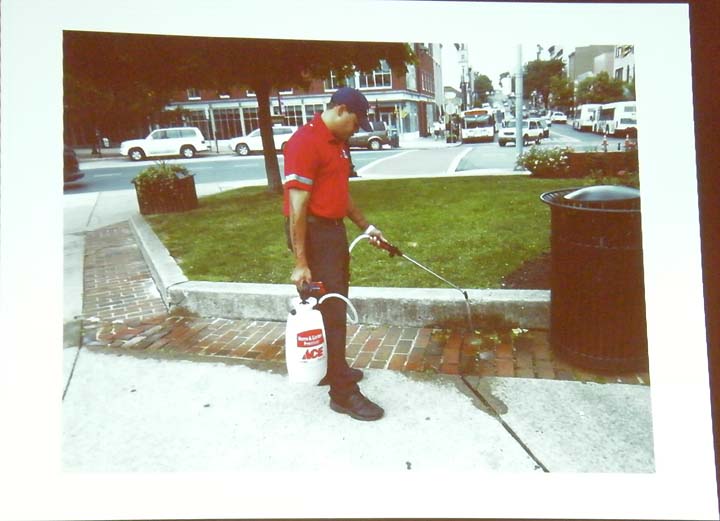
While the Ambassadors' territory no longer includes Fifth Street, the red-shirted welcome and clean-up assistance crew continues its mission of “Clean and Safe,” with a focus on making city visitors and residents feel comfortable in the heart of Downtown, Levisay said.
“We probably have an Ambassador (on the Center Square) all day or most of the day,” she said.


The crew is estimated to have done 170,000 “hospitality greetings”--that is, saying hello to city visitors last year.
“When you get out of your car and have someone say hello to you, I think you feel more comfortable,” Levisay said.
 In addition to their never-ending task of keeping the streets tidy, Ambassadors go through bi-weekly training sessions on a number of topics pertaining to their jobs, from first-aid to social skills, aimed not only at visitors, but residents that may be in need of social services, she said.
And, the crew is tasked with taking care of the 106 city planters and six flower beds, Levisay noted.
“We'd also like to get people to know the police department a little bit,” she said.
She added the Ambassadors are there at all EFM and Main Street events too.
“We support Main Street,” Levisay said. “Anything they do, we're at their side.”
Though the NID's rejection means the Ambassadors funding is limited to what the city budget, GEDP and private donors provide, the crew is still acomplishing its mission, she said.
“We're still doing the same things,” Levisay said. “We're just squishing the area a little bit.”
Easton Main Street Initiative
 The Main Street program, run by two paid full-time employees and 60 unpaid volunteers, has worked hard since it's inception in 2005 to further its mission to “continue the economic stability and economic development Downtown,” said EMSI director Kim Kmetz.
The EMSI received a $50,000 grant from the Department of Community and Economic Development, $55,000 from Northampton County, $10,000 from the Easton House Tour and additional money from proceeds from the Easton Haunted Walking Tour in the past year to help foster its efforts at strengthening the city's growth, she said.
 The program's organization, design, marketing, events, and economic structuring committees, populated by volunteers, all focus on various aspects of the effort, including ideas for vacant properties and producing promotional materials, posters and brochures. Still, it's a big job that the EMSI does, she said.
“We could use more volunteers,” Kmetz noted.
 The EMSI has sponsored several concert programs, along with various mural and art projects in the Downtown, including artist-created bike racks.
“It's like it's own little walking tour,” she said of the bike racks. “We see them being used more and more all the time.”
 Seventeen new businesses, along with five new restaurants, have opened or plan to open by year's end, Kmetz said.
“Of course, we always lose some,” she noted. “But every time, we step up next time.”
EMSI has conducted surveys too of the kind of businesses local would like to see open in the Downtown too. High on the list are a drycleaner, a fitness center, along with more clothing shops. Also, some expressed a desire for a shoe store, Kmetz said.
“We want people to live here, and we don't want to give people a reason to get in the cars and drive away (for these things),” she noted.
 In the works for 2013 is a smartphone app highlighting Downtown businesses and attractions, as well as services like parking, and a gift card program.
A necessary update to the Main Street website delayed development of the the app, and other projects delayed the gift card being introduced, Kmetz said.
“We hoped to get it out by the holiday season this year, but that's not going to happen,” she said, adding she expects a gift card program will be announced in spring of 2013.
Also planned for 2013 are improvements to the northwest quadrant of Centre Square and the pedestrian walkway under the Route 22 overpass on North Third Street, as well as a “free library book boxes” in Downtown parks.
 She said lighting and pressure washing the stained stones along the sidewalk would help entice more Lafayette College students to walk Downtown and reinforce efforts Main Street has been making to make the students feel comfortable in the city.
 “Town and gown relations are extremely important,” Kmetz said.
Promoting Easton is also still forefront in Main Street's efforts too—EMSI will continue to engage Rick Ferrell , a recruiter based in Delaware, under contract since 2008, along with using the donated time and efforts of several local graphic designers and photographers, she said, and will make a special push for the holiday season and Peace Candle lighting ceremony this year.
 “If we had to pay for photography and design, I don't know what we would do,” she said. “We market Easton for the holidays.”
Volunteers will also lead “Easton Fam Tours” during the fall into the holiday season, Kmetz said. The tours are designed to familiarize newcomers and visitors with Downtown shops.
 “People get a little turned around because the stores aren't all on one block,” she said.
But Easton's charms outweigh any confusion.
“We have an authentic Downtown experience,” Kmetz said. “People (elsewhere) try to replicate that, but we have the real experience.”
Liz Rosen, of the EMSI Advisory Council and Design Committee chair, noted that she and Advisory Council chair Holly Edinger, conducted surveys during Heritage Day this past July to gauge visitors' experiences in the city.
“We had really positive comments,” Rosen said.
Edinger praised GEDP for their management of the program.
“Some people seem to think GEDP is this mysterious organization, but it's just the organization we work under,” Edinger said.
Longenbach agreed, saying when it comes to Easton's economic development, “GEDP is an incredibly important part of the puzzle.”