 |
| Ravenwood, as it is today, off the corner of Ferry and Walnut streets in Easton's West Ward, is the result of a lot of labor...and love. |
And, if you're not a life long city resident, it's easy to believe that this beautiful home has always been this way. However, that is not so.
While originally built in Easton's late 19th century heyday, Ravenwood's amazing old world charm and beauty is actually more of a survivor's tale, and the building's story in the past 30 years reminiscent of that of a phoenix rising from the ashes after near destruction.
For nearly destroyed it was. In the early 1980s, Easton was still reeling from the effects of the federal “urban renewal” projects that swept America following World War II, reaching culmination in the 1960s and '70s.
The concentrated federal pressure to declare city neighborhoods “blighted”, even thriving ones like Easton's Downtown commercial district, drove much of the urban middle- and upper-class out to suburban developments, leaving the surrounding neighborhoods to suffer from severe economic and social decline.
 |
| Earl Ball in front of Ravenwood, in the mid 1980s. Faux brick tar paper covered the exterior clapboard, windows were missing glass, the electrical and plumbing systems needed complete replacement, and rooms were strewn with trash when architect Timothy Hare purchased the property. Below, the house is shown as it continues to undergo renovation, more than a year later. |
“It was condemned,” Hare said. “So you couldn't get a mortgage or fire insurance for it.”
 |
| Earl Ball in the 1980s, removing trash from Ravenwood's yard. |
“The yard was even worse,” Hare said. “There were just mountains of garbage and debris.”
 The surrounding homes were not any better off. Revitalization in Easton was barely in its infancy, and a row of nearby abandoned vacant homes was being auctioned off by the city for paltry four-digit sums under the “Old Homes” program of the time.
In the early 1980s, Ball and Hare were living in the Village in Manhattan but had met at Easton's first Heritage Day celebration in 1976. They fell in love at first sight, both agree, and they have been partners ever since—legally married in the several states that allow it, as well as in Canada.
Hare was also very familiar with Easton, having lived in the city in years prior and instrumental to saving the building that now houses the Quadrant Bookmart and Coffeehouse, along with securing the halt to the plan of bulldozing the rest of Downtown.
Living in New York was losing its appeal, but neither saw the suburbs as an ideal haven. So despite a number of reservations about the property, Hare took the plunge and bought it.
“We came in with snow shovels every weekend and shoveled it out,” Ball said. “I could see the potential though, even though there was no glass in the windows, and the wood was hatcheted.”
 |
| Tim Hare and Earl Ball, with Fluffy, in the front parlor of Ravenwood, talking about the work that has been put into their antique townhouse's restoration |
 |
| Earl Ball shows off the woodwork on the home's fireplace, in what was originally the house's kitchen. |
Getting to the point where they could even move in took a couple of years of steady hard labor, they said.
The plumbing and electrical wiring were not only outdated, but essentially destroyed from the many years of vacancy and neglect the property had suffered. So it all had to be replaced.
And, even when they finally moved in, the house was still a constantly ongoing project.
Many rooms had pink walls over layers of wallpaper, and in others the plaster was badly damaged. The townhouse's original clapboard had been covered over with tar-paper with a faux-brick pattern at some point, which all had to be removed and the staple holes in the wood filled prior to the exterior being painted.
 “I enjoy the process of restoring (old things) and bringing it back,” he said of what many would label tedious tasks.
A number of the house's details had been removed during its decline, such as doors, and had to be replaced, however. Not willing to compromise the house's historical details, Hare scoured curbsides near old house cleanouts both in Easton and in Harrisburg where he was working at the time, and brought home architectural details appropriate to the house to be incorporated into the restoration.
 |
| Earl Ball holds a photo, shown below, of how the room he's standing in appeared , in the mid- to late 1980s before work on the house was complete. |
Ball spent countless hours and days, meticulously working room by room personnally to restore details in the wood trim that had been hacked and damaged and fixing damaged plaster work, as well as painting the exterior himself, twice now in the time the couple has lived there.
The process has taken many years to complete.
 “I enjoy the process of restoring (old things) and bringing it back,” he said of what many would label tedious tasks.
A number of the house's details had been removed during its decline, such as doors, and had to be replaced, however. Not willing to compromise the house's historical details, Hare scoured curbsides near old house cleanouts both in Easton and in Harrisburg where he was working at the time, and brought home architectural details appropriate to the house to be incorporated into the restoration.
 |
It saved a lot of money, Hare said, and was also in keeping with the couple's goal of revitalization and renewal for the antique home.
Today, 28 years after Ball and Hare started its restoration, Ravenwood may well be more grand than it was when it was originally built. The two have additionally added an enchanting garden, and bought the adjacent vacant lot, which they have also improved by cultivating more garden space.
Having tracked down its history, Hare said the house was built for Easton blacksmith and carriage maker Eli Oberly and his family, and probably completed in 1871. Oberly, he added, was prosperous but not a very rich man.
 |
| The "servants' staircase" |
 |
| The main staircase |
“So while this was a big house, it wan't a fancy house,” Hare said.
Still, the house has a plainer, second staircase for servants' use leading to the second floor in addition to the grander staircase off the foyer, and while converting the third floor attic space into an open floor plan, there was evidence this space was used at one time for servants' quarters, an indication Oberly was probably doing fairly well.
The attic space also yielded some bits of history that were preserved despite the house's near fatal decline prior to its restoration and hint at previous owners' lives.

 A trunk hidden away in the attic servants' quarters contained clothes, including an apron, a late 19th century corset and bust enhancer.
 A woolen cap, typically the type a workman or young boy would wear was also found by Ball in the walls, along with a stash of beer bottles from an old Easton brewery.

 And, in the yard, bottle and pottery shards, along with the “prize” of finds—a belt shield from a Union soldier dating back to the Civil War.
Ball has carefully kept and preserved these and other artifacts he's found, labeling them along the way. They're part of the house and its history, he says.

But while Ball and Hare happily live among the fruits of 28 years of patient, meticulous labor and still love the neighborhood, they both have recently retired and say it's nearing time to pass their historic home to the next generation.
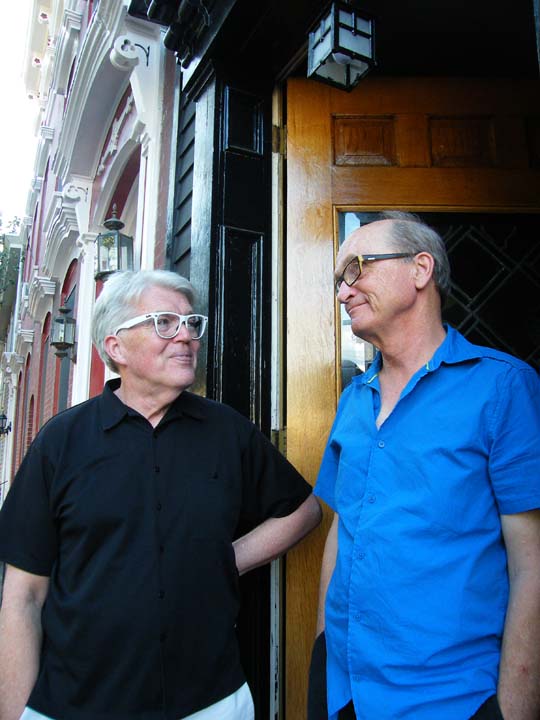 “This house needs someone younger, a family, perhaps, to carry it forward into the future,” Hare said.
To that effect, an ad on the Manhattan Craigslist appeared last week, declaring their intention to sell to the right buyer. The adjacent garden lot they will keep for now, but intend to allow first-option rights to whoever purchases Ravenwood.
They intend to stay in Easton, they said too, adding that they're not sure where they will move, but it won't be College Hill.
“We like the diversity of this neighborhood,” they said. “So wherever it is, we're not giving that up.”


 Ravenwood is only one of a near-countless number of unique, one-of-a-kind historic buildings in the City of Easton, and The Easton Eccentric would like to highlight more of them. Are you currently restoring one of the city's numerous architectural gems? Do you own a house or other building that you'd like to highlight? Or, perhaps there's a structure you feel deserves some attention so it can get the love it deserves to further the mission of revitalizing our city?
If so, please email us! Your suggestion could very well be next on our list!


