Showing posts with label municipal pensions. Show all posts

Wednesday, September 18, 2013

Despite $2M Gap, City Administration Hopes to Hold the Line on 2014 Property Taxes

By Christina Georgiou

Easton Mayor Sal Panto announced Wednesday afternoon
that the city faces a serious budget gap, but he
hopes to hold the line on city property taxes for 2014.
 The City of Easton is facing a serious budgerary shortfall for 2014, but the city's administration doesn't intend a property tax increase to cover the gap, Mayor Sal Panto said at a press conference Wednesday afternoon.

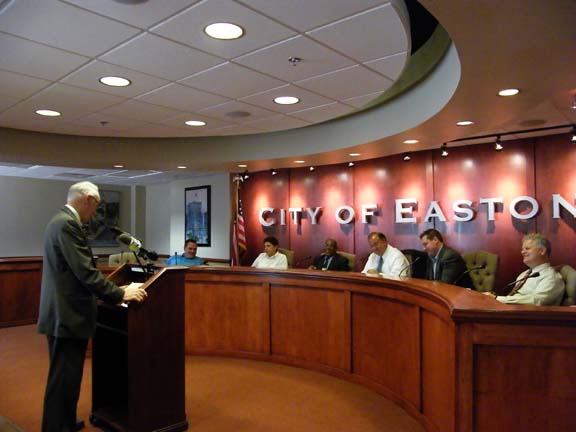
The mayor will present the 2014 budget proposal at a special meeting on Tuesday, Oct. 1 at 6 p.m. in city council chambers in accordance with the city's Home Rule charter stipulations, but city council members won't be deliberating on it until later in the month or even later.

"Usually they wait until November to start the hearings," Panto said, adding that changes to the initial proposal are nearly inevitable during the process.

"I will tell you this budget is a very difficult budget," he said. "Our big problem is healthcare (costs)."

The City of Easton is self-insured, and 17 major employee medical claims this year drove up the  city's healthcare costs far more than than is usual or than that city officials could anticipate, he said.

"Our healthcare costs (estimates) this year look like they're under by about a million dollars," Panto said.

That amount is in addition to another $1.8 million shortfall that city officials said they already expected due to rising costs, including those of city pension expenses. Together, pension and healthcare costs will total about $24 million in 2014.

Though an estimated $1.2 million savings on the city's new trash contracTot is expected, there is still about a $1.6 million gap that still needs to be covered, Panto estimated.

"Tough decisions are going to have to be made," he said. "It's going to be a tough year."

Panto said he's not sure exactly what adjustments the administration will propose, but possibilities include cutting back or closing city swimming pools next year, closing one of the city's fire department substations, and/or not hiring for vacant positions in city hall.

"Our swimming pools lost a lot of money (this year)--over $100,000," he said, adding that cutting back on recreation or fire department substation expenses are two possibilities that have been discussed but rejected previously in the face of budget gaps. "Those issues might come up again."

"Right now, we're looking at vacant positions that maybe we might not fill," he said, adding that at this point, city employees layoffs are not an option that is being considered.

Reducing expenses or city services is a better option though, than raising property taxes, Panto said, though it's still possible that some fee increases may be proposed instead.

"I just can't see increasing taxes on people that are unemployed and seniors," Panto said.

The current city property tax is sitting at about 29 mills, less than the maximum allowed to the city under state law.

"We could go over that," he said. "It's just that I believe it's not fair."

He added, "My primary goal is no increase in property taxes, and my second priority is no increases of any kind."

Updated at 4:41 p.m. to add a photo.

Tuesday, September 25, 2012

Easton Affirms Employee Pension Agreement

By Christina Georgiou

Easton's pension agreement for city workers was updated Monday evening to keep current with federal IRS regulations and allow workers to invest more of their paychecks towards retirement.

City admnistrator Glenn Steckman said the city's pension agreement hadn't been officially updated since 1993, but the document is essentially the same from a financial standpoint.

"The IRS requires language updates for pension law compliance," he told council members. "That is the primary change. It is just legal language."

Steckman added, "It's memorializing what's been a practice here--that part-time employee's aren't eligible."
Active members of the pension plan are still grandfathered in and the vote doesn't change those benefits, he noted.

The pension plan as approved stipulates that regular full-time city employees contribute a minimum of 6 percent of their paychecks into their future pensions, but may contribute up to 16 percent if they wish. The former limit was 10 percent.

City Finance Director Chris Heagele said the limit increase was in reponse to requests from some city employees.

"It's the same as a private employer's 401K," Heagele said. "You get a guaranteed return of 6 percent. Unless you can find an investment that guarantees more than 6 percent, it's an excellent place to put it."

If the fund generates more than 6 percent, the difference is split between the city and the employee, he said.

Heagele noted the PMRS fund is separate from the defined benefits pension city employees receive upon retirement.

"Defined benefit is provided by the city without contribution from the employee," Hegele said.

Any money the city receives from an overage will go toward paying for employees' defined benefits, he added.

The employees' pension plan is backed by the State of Pennsylvania, and does not include police or firefighters, city officials said.

The cost of police and firefighters' pensions is backed by the city directly, and keeping up with costs recently was behind the controversial decision to approve a "commuter tax" to help pay sharply escalating costs.

"This isn't the pension plan that's been killing us," Councilman Mike Fleck said.
Mayor Sal Panto concurred.

"I wish everyone were still in the PMRS fund, instead of the city-funded pensions," Panto said. "(Those cost) about $100,000 per resident, and it's killing us."

The new document outlining the PMRS pension plan passed 6-0. Councilwoman El Warner was absent.

Wednesday, July 18, 2012

Commuter Tax Is Not the Answer to Decades-Old Problem

Guest Opinion/Editorial


By Jeff Warren

When it comes to government finances, we hear the catchphrase all the time – "we need to do more with less."  These words are uttered from public officials in the federal government to our local school board members. This is also painfully true in millions of households across America as we continue to see costs rise and wages plateau. Settling for the "same ol’, same ol’" just isn’t working any more when darker financial pictures are on the horizon, especially when it comes to local government’s public pensions.

Earlier this year, my City Council colleagues and I were presented with a proposal that would raise the commuter tax on all non-residents that work in the city from 1 to 1.75 percent. City Council has been  advised that the tax is needed to cover $1.35 million of a projected $1.85 million shortfall in the city’s pension obligations. Raising the commuter tax would soften that blow.

First, there is genuine concern within our business community that this tax will be a deterrent for commuters and patrons to support our city and for employers to want to stay and keep operating their businesses. Will small business owners living outside our borders want to pick up and relocate their businesses to Easton?  Will we witness merchants taking their business elsewhere? What will happen to our local economy?

Second, there is a concern that we will hurt and deter regional cooperation by targeting other’s paychecks and wallets. Will our neighboring local governments be discouraged to embark on inter-municipal agreements down the road? Will we begin an alienation process that lasts for decades as we strive to enhance cooperation? Do we balloon and manifest the “city vs. suburbs” mentality that is already prevalent here in the Lehigh Valley?

These are all valid questions that have no easy answers, but they contribute greatly to the debate. The overall question as we move forward is: why is this happening, and why is the commuter tax even an option?

Laws mandating defined benefit plans for municipal workers’ pensions are the issue. Investment losses affect contribution requirements instead of the benefits. Further, state law currently prevents municipalities from making the changes they might want to make to their pension system.

Accordingly, our state government then graciously allows local governments to institute a commuter tax to specifically help fund pensions. If one looks at the overall picture, this is a mechanism for the state to continue passing the buck onto our local municipal governments.

Harrisburg needs to step up to the plate for every taxpayer, worker and local government in the Commonwealth and address the pension issues that truly affect us all. While the General Assembly worked on the public pension issue in November 2010, the end result did not go far enough. In essence, the state legislature continues to push costs down to local governments and ultimately, the taxpayer. They need to come to the aid of local governments and they need to do it now without hurting Pennsylvania’s workforce in the process.

City Council, in the meantime, still needs to find a solution to the gap in our pension obligation.

I, along with other City Council colleagues, have been a proponent of instituting a PILOT (payment in lieu of taxes) on properties within Easton that are tax exempt.

If one were to look at the dozens and dozens of properties in the city that have received tax exempt status over the years, one would be shocked. The PILOT option would generate significant revenue for the city, since over 40 percent of the property in Easton is tax exempt.

Finding solutions and mechanisms to cut costs within local government budgets is increasingly difficult. It is the main reason the concept of regionalism must remain at the forefront of the Lehigh Valley’s public agenda for the long-term. Municipal governments like Easton must have the opportunity to enhance our ability to enter into inter-municipal cooperative agreements with our neighboring municipalities in order to cut costs.

From my seat on City Council, a commuter tax doesn’t seem to be the best solution to a decades-old problem. In the end, it’s just not good government, which is perpetrated by the Commonwealth. While it is never a good time to place an added tax on individuals, at this point in our economic recovery it’s certainly  not ideal. It penalizes middle-class working families who are lucky enough to be employed, isolates our neighbors, and may very well hurt Easton’s local economy for many years to come.

Jeff Warren is an Easton City Councilman.

The Easton Eccentric welcomes guest posts on any topic of local concern. Do you have something to say? Would you like to see your thoughts and opinions printed here? Email us!

Tuesday, July 17, 2012

City Council Pushes Back Date for Final Vote on “Commuter Tax,” Agrees Regional Revenue Discussion Needed

By Christina Georgiou

 Easton City Council agreed Monday evening to push back voting until Wednesday, August 8 on a proposed “commuter tax,” which would require those who work but do not live in the city to pay an additional 0.75 percent in Earned Income Tax (E.IT) beginning next year.

Vice Mayor Ken Brown requested the move, saying he'll be away for the next meeting but very much wanted to be present when the matter is up for the final vote.

The delay in deciding the matter came at the close of an hour-and-fifteen-minute hearing that was sparsely attended by the public, though Northampton County Executive John Stoffa was notably present.

Northampton County Executive John Stoffa suggested
non-profits pay a portion of property tax and that Lehigh
Valley elected leaders meet with state officials to press for
changes at the state level to munipal pension requirements.

Following a recap of why the EIT seemed most fair of the city's present options to to help cover a looming deficit in the city's pension fund by Mayor Sal Panto, Stoffa addressed the council, and made two suggestions for a joint effort for the county and city to help combat a problem he said both entities face.

“I have sympathy for a problem you inherited without a solution,” Stoffa said.

Of the 1,101 Northampton County employees, 103 live in city limits, he said.

“I'm here to help you understand how this will affect more than Easton.,” Stoffa told the council. “We face the same issues you do. One thing you don't have is is 11 unions to negotiate with.”

The county executive suggested that a meeting be set up with between local Lehigh Valley elected leaders along with state representatives to discuss the issue of unsustainable costs municipalities face.

“We've never had that in the history of the Lehigh Valley,” Stoffa said.

Stoffa also suggested that non-profit and other organizations that are exempt from paying property tax be required to pay a severely reduced rate instead, the revenue from which could be used to help close the gap in municipal pension payments.

“I think the time that non-profits pay nothing is over,” Stoff asaid, adding that a rate between 10 and 20 percent of what would be owed by a for-profit or residential homeowner seemed reasonable.

Panto noted that for that to happen effectively, a county reassessment of properties would need to be undertaken.

“Our assessments are 25 years old. But with the recession, maybe they're accurate. I don't know...” Panto said, adding, “I do know the one for Lafayette College is woefully low.”

Panto said past meetings on shared regional issues have been productive, and that it seems like the city and suburbs do have common issues to be faced.

“Sooner or later, they're going to be grown out, and then the only way (to make up necessary revenue) is to raise taxes,” he said.

Stoffa, the mayor and council members all agree that municipal pensions are unsustainable at the current rates, and that the issue is one that affects nearly every Pennsylvania municipality, they said.

“The state holds all the cards,” said Councilman Jeff Warren. “Why they haven't addressed it, I don't know. They know what we're going through. Why they haven't stepped up to the plate, I don't know.”

Warren's comments echoed those of Panto made earlier, as well as those made by fellow councilman Mike Fleck.

“We do need real pension reform. But the state is laughing at us,” Fleck said. “Because no one is yelling at them, and they think they'll be re-elected.”

Fleck also said he was disappointed that Stoffa was the only county representative present at Monday evening's hearing to discuss the proposed measure, which county council voted 8-0 to condemn in a recent resolution.

He added he felt the council was being reactionary in that move, and were being “critical to make themselves look better.”

“I'm really disappointed with our representative, (Bob) Werner, when he knows us and could have talked to us,” Fleck said. “I'm disappointed in County Council as a whole, not the administration.”.

Only one member of the public commented during the hearing, Joey Cervenka, of Forks Township, who works for a privately-owned firm in the city.

Joey Cervenka, of Forks Township, who works fo
r a privately-owned firm in the city. was the only citizen to
voice an opinion Monday evening. Especially frustrating,
he said was the fact that Easton 's pensions would be getting
a larger share of the EIT he'd pay than the school district.
Clarifying that if passed, he'll pay 1.75 percent EIT, of which 0.5 percent will go to each Forks Township and the Easton Area School District, with the final 0.75 percent to the City of Easton, Cerevenka said he felt the tax was unjust.

“What's frustrating is that more will go to pensions than schools.”

He wondered too what there is to stop the city from raising the amount again.

Panto said that while the city can theoretically raise it higher according to the city charter, that he didn't think it would be fair to charge non-residents a higher tax than residents, who in the unlikely case of another EIT increase, would see it before non-residents.

The mayor suggested Cervenka contact the state senator about the issue of pension reform as well.

While members of council and the mayor still seem likely to vote in favor of the “commuter tax” proposal in August, some said Monday they were of mixed feelings about it.

Councilwoman El Warner said she came to listen to input at the hearing Monday evening, noting there will be other times for her to voice her thoughts on the issue.

Councilman Roger Ruggles said he's still thinking about the right thing to do.

“I have mixed feelings on this,” Ruggles said. “The city itself is the center of the community. And if the city is not a good place, then surrounding municipalities suffer. It's hard to say what' fair. It's a really, really difficult decision.”

He added, “I think working together is a much more effective way of doing things. It's not us and them. It's us.”

Warren agreed.

“We need to continue with regional agreements,” Warren said. “Government leaders need to embrace that.”

Though the matters of currently exempt entities paying property taxes and potential proposals for revenue and shared service agreements seem likely to be addressed in the near future, whether they will take the place of the revenue a “commuter tax” would raise or whether agreements can be reached before the city needs to make a final decision on how it will pay an estimated $1.4 to 1.8 million deficit in its pension system in 2013, seems murky at best.

If not for the ongoing recession and the resulting high unemployment and underemployment, Panto noted too, the city would have enough in from EIT at current rates and would not be considering the current move.

“I really thought the recession would come to an end, but that's not going to happen,” the mayor said.

Northampton County Council meets at 6:30 p.m. on Thursday, July 19, Stoffa noted, adding that he will be bringing the idea regional municipal elected leaders up then too.