Showing posts with label urban renewal. Show all posts

Thursday, March 13, 2014

Mayor Says Continued Development Key to Easton's Improved Economy

By Christina Georgiou

Easton Mayor Sal Panto gave the annual "State of the City" address to
city council Wednesday evening, with about 20 members
of the public in attendance.
The city's revitalization efforts of the last three decades are paying off, and Easton is on a much more solid financial footing than it has been in a long time, Mayor Sal Panto said in his State of the City address to city council Wednesday night.

"Unlike many cities throughout the northeast, Easton has weathered challenging economic times, and we remain steadfast in our determination to move progressively and positively toward a better future," he said. "As mayor, I am committed to harnessing the physical, cultural, and intellectual strengths of our city, transforming those matchless qualities into sustainable and unrivaled developments that will benefit residents and visitors alike."

Urban renewal was more like "urban
removal" for Easton, Mayor Sal Panto
noted. Revitalization and adaptive
reuse over the last 30 years has
be key to the city's turnaround since
then.
 Showcasing dozens of city buildings that have been redeveloped over the past thirty years  with before and after photos, Panto said that urban renewal during the 1960s, 70s, and early 80s, were more like "urban removal," and contributed to the city's decline during that period.

He credited former mayors Thomas Goldsmith, Michael McFadden, and Phil Mitman with continuing revitalization efforts after his own first mayoral tenure, beginning in 1984.

Despite the gains that have been made, the city needs to continue on its redevelopment trajectory to grow the population and keep tax rates down, he said.

A sketch showing the Easton Home's plans to add senior
apartments along Northampton Street in the city's West Ward.
"Our population fell below 30,000 (during that time). We need to get it back up so there are more people living and working in the city and paying taxes," Panto said.

The redevelopment and adaptive reuse of existing properties in Easton, such as the nearly completed Pomeroy Building, which houses two restaurants, office space  and more than 40 residential apartments, brings new tax revenue to city coffers, he said. Other planned projects, such as the conversion of the Governor Wolf building into upscale apartments and the redevelopment of old industrial sites such as the Simon Silk Mill on South 13th Street, will add to that.

"The Governor Wolf building will be coming back on the tax rolls in the next 30 to 45 days," Panto said. "You're going to see some major development going on (at the silk mill site) after the weather breaks."

New construction will also contribute to the city's well being too, Panto said, pointing to Lafayette College's plans for a new arts complex on North Third Street, and the Easton Home's plan to add senior citizen apartments on Northampton Street in the West Ward, as well as the new city hall and transportation center that is expected to be complete late next year.


"I think anyone who lives in that area of the West Ward will feel better about their neighborhood," he said in reference to the Easton Home project.
Investments of more than $420 million over the past six years have translated into more than just improvements in the city's infrastructure too, Panto said.

Overall crime in the city was down by 22.5 percent, and sound fiscal management, which has resulted in an "A+" bond rating for the city, are good news too, the mayor said.

"We'll save over a million dollars because of our credit score," Panto noted.

Still, Easton faces challenges in the years ahead.

Highlights from various city departments' annual reports
Click on any image for a full-size view
"We're very concerned about our pension costs...but we're doing much better," the mayor said. ""We've been trying to live within our means, but it's not easy...legacy costs will eventually put...every municipality in the Commonwealth under if our legislature doesn't do something soon."

Easton should continue on the path it's on, and that will mean a rosy future for the city, Panto said.

"We were elected on progressive change," the mayor said, adding that positive changes should not come at the expense of any one group over another.

"We've done this without gentrification. We have not pushed people out," Panto said. "The state of our city is progressing, growing."


Thursday, January 9, 2014

City Agencies Seek $650,000 in Grant Funding

By Christina Georgiou

Easton City Council members listen to presentations
on three grant applications totaling $650,000, that
will, if approved by the state, support various ongoing
revitalization efforts in the city.
Easton's city council backed three grant applications seeking a total of $650,000 in state funding to support various programs related to ongoing revitalization efforts at its meeting Wednesday evening.

The West Ward Neighborhood Partnership (WWNP) is seeking $50,000 from the state in support of its Elm Street program, which would go towards sidewalk and porch renovation grants for eligible homeowners in the neighborhood, along with the addition of more street trees and support for new signs for commercial endeavors in the district.

"We want to continue the funding even though it's less than previous amounts because we want to continue our programs," WWNP Director Esther Guzman told city council members.

Mayor Sal Panto said he very much supports the work the WWNP does and lamented that more state funding to support isn't available.

"We used to get $250,000," he said. "The state continues to balance its budget on the back of the local programs."

The Elm Street program, intended to support revitalization in older residential neighborhoods, was initiated by local state Representative Robert Freeman (D-136), Panto noted.

"Even at $50,000, we're going to take these baby steps," Panto said. "It's making a difference."

The Easton Redevelopment Authority (ERA) will seek a $300,000 Keystone Development Grant through the state's Department of Community and Economic Development to rehab four blighted properties--two in the city's South Side neighborhood, and two in the West Ward.

"Without these funds, these properties will just sit as they are and continue to deteriorate," said ERA community development specialist Michael Brett.

Panto said that in addition to eliminating the hazards blighted properties pose, rehabbing as many dilapidated properties as possible in the city is ultimately a strategy for keeping taxes lower.

"I also believe the more population we have as we grow out of the Urban Renewal era...will help us to control costs," he said, adding that he wants to ultimately see the city population top 30,000. "Sustainability comes in a lot of flavors, and rehabilitation of old homes is a part of that."

Another $300,000 in grant funding is being sought by the Greater Easton Development Partnership to support the Easton Farmers' Market's Public Market, to be housed in the former Weller Center at 325 Northampton St.

The money will be used for a revolving loan program that will support capital purchases of vendors' start up costs at the market, and matching fund requirements for the grant have already been satisfied by the city's grant of $1 million to parent organization Greater Easton Development Partnership (GEDP) last year to purchase the building, project manager Jared Mast told city council members.

"As these vendors repay the loans, the funds would be put in a revolving loan account...that would be available to new or existing businesses in Easton," Mast said.

He added that the advantage to both Public Market and other business owners in the city is that interest rates would be substantially less than bank rates for the loans.

ERA and GEDP Director Gretchen Longenbach said that the ERA "doesn't intend to recover any money" for the first two grant applications, the $300,000 for the Public Market loans, if approved by the state, would serve the city's business community well in the long run.

"We hope to help multiple businesses and entrepreneurs," she said.

She added that it was initially hoped the city might be eligible for even more funding than is being applied for in all three projects, but was advised by the state to "streamline and prioritize" when it came to the Keystone Grant applications.

Wednesday, May 15, 2013

Easton Honors Individuals, Businesses for Perseverance

By Christina Georgiou

About 125 people, all long-time Easton residents and business owners, gathered at the Sigal Museum Tuesday evening for an awards ceremony held by the city to honor those that have aided in the economic and cultural successes the urban area is currently enjoying.

Easton Mayor Sal Panto, emcee of the event, praised the efforts and drive of the award recipients, which included 56 businesses and 27 individuals, noting they persevered when the city was suffering from blight and suburban flight.

"We are ever so fortunate to celebrate the many new businesses and restaurants coming to our city, and we should celebrate their arrival.  However, tonight we are here to honor those that stayed, those businesses that have made Easton their home for more than 20 years.  Tonight we honor those businesses and individuals who have seen the best times and, unfortunately, the worst of times, for our city.

"To the individuals who stayed, and to the individuals that stopped the demolition, we wish we could give you more than a certificate, but know that we deeply appreciate what you all have done for Easton," Panto added.

Panto said the drive to save Easton from the devastating effects of the federal government's "urban renewal" projects was not universal, and many gave up, but those that didn't are responsible for the preservation of numerous city landmarks that residents and visitors enjoy so much today, such as the State Theatre and the Bachman Publick House.

"There were Hollywood companies that wanted to take (the State Theatre) apart piece by piece, because it really is beautiful," he said. "But the amazing thing is, it wasn't the most beautiful theater in Easton. There were seven others."

The others were all destroyed during the urban renewal period, but involved, concerned citizens managed to buy the State Theatre for $25,000, form a non-profit group, and eventually restore it, he said.

Antonia Mitman talks about
her efforts, with others, to
stop the demolition of the
State Theatre and other
buildings in Easton.
"No one thought we could do it," he said. "It was a time of conflict and disagreement.  It was a time when Easton was trying to react to the flight to the suburbs by trying, although unsuccessfully, to turn itself into a suburb."

Antonia Mitman, who was part of the group that worked toward that goal, said she got involved after her mother, tired of hearing her complain what was going on, told her to do something about it.

"It wasn't the most popular thing," she said, adding that Easton's success in fighting urban renewal and its effects is an anomaly. "Stories like this are uncommon. There are so many cities in America that are dying on the vine."


Timothy Hare, received special recognition Tuesday evening
for his efforts towards preserving historic buildings in Easton,
including the Quadrant.
Architect Timothy Hare, also honored last evening, who worked to save the Quadrant and other Easton buildings from the wrecking ball, said he did it because although he was a newcomer at the time, he felt the city was beautiful and unique, and didn't want to see it destroyed.

"I saw Easton the way it could be," he said.


Easton Longevity Award recipients:
(for businesses in the city for 20 years or longer)
  • Wolper Subscriptions, 20 years
  • Connexions, 23 years
  • Marie’s Dance Studio,  25 years
  • Antonio’s, 26 years
  • Panche, 26 years
  • The Strand, 28 years
  • American Printing Unlimited, 29 years
  • 42 North Second Street, 30 years
  • W-Graphics, 30 years
  • Mother’s, 30 years
  • Josie’s New York Deli, 31 years
  • Aura Ceramics, 32 years
  • Joe Parsons
  • Investment Advisors Management, 35 years
  • Quadrant Books, 35 years
  • Elliott and Elliott, 35 years
  • Wawa, 36 years
  • McDonald’s, 36 years
  • Nature’s Way, 38 years
  • Lafayette Bar and Hotel, 38 years
  • Genesis Bikes, 39 years
  • Angelo’s Restaurant, 40 years
  • EPA Title Company, 40 years
  • Lewis and Walters, 42 years
  • Utopia, 44 years
  • Industrial Communications, 47 years
  • White Singer Sewing, 50 years
  • Leo’s Barber Shop, 52 years
  • Monarch Furniture, 61 years
  • New York Tailor, 61 years
  • Joe’s Market and Deli, 62 years
  • Colonial Pizza, 65 years
  • Jack n’ Jill Studio, 66 years
  • Easton CafĂ©, 68 years
  • The London Shop, 74 years
  • Emmanuel Travel, 78 years
  • Luco’s, 78 years
    Members of the Bassil family, owners of the Carmelcorn Shop, pose for a
    photo with Easton Mayor Sal Panto, after receiving recognition for the
    shop's longevity.
    
  • Carmelcorn Shop, 82 years
  • Easton Upholstery, 87 years
  • Kaplan’s Awnings, 90 years
  • Kressler Wolff and Miller, 90 years
  • Lauter’s Furniture, 98 years
  • Halpin’s Garage, 99 years
  • Prudential Paul Ford Realtors, 100 years
  • Herster, Newton and Murphy, 110 years
  • The Express-Times, 158 years

Easton Award recipients:

(for preservation of The Bachman Publick House)
  • Robert Butow
  • Nancy Summerill Butow
  • James J. Chester
  • Marianina Savoia
  • Bob and Karen Doerr  (and Phoenix Fire House restoration)

(for preservation of The State Theatre)
  • Richard Wolff
  • Ken Klabunde
  • Charlie Smith
  • Gail Brogan
  • Andy Daub
  • Lee Grifo
  • Nancy Sanquist
  • Pat Marhefka  (deceased)
  • Dick Cornish  (deceased
  • Antonia Mitman

Honored for their participation in the "Historic Easton Movement":
("The rebels of the 80s")
  • Dale Falcinelli
  • Mary Koch
  • Steve Glickman
  • Paul Felder
  • Jeff Gilbert
  • Oliver Andes
  • Karl Stirner
  • John Cappellano
  • Bryant Matyger
Special recognition:
  • Timothy George Hare
  • Former Mayor Phil Mitman

Thursday, May 9, 2013

Longtime Downtown Easton Businesses, Dedicated Citizens to Be Honored

A number of businesses and individuals will be honored at an awards reception that will be held at the Sigal Museum next Tuesday, May 14 at 6 p.m.

Mayor Sal Panto said several people will be recipients of the newly created "Easton Award", designed to honor individuals who have "made significant contributions to the preservation of our historic resources" and helped to save city historic buildings from demolition during the "urban renewal" plan of decades.

"These individuals invested of their time, money and talents to pave the way for successes being realized today. Through their efforts Easton is a better city," Panto said in a media release about the ceremony.

He added at Wednesday evening's city council meeting that the preservation efforts of individuals saved a number of iconic Downtown buildings from being demolished, including the Quadrant Bookmart and Coffee House and the State Theatre.

About 35 longtime city businesses will also be recognized and be recipients of the city's new "Longevity Award", to be bestowed on businesses that have been in business and stayed in downtown Easton for more than 25 years.

"Sometimes we forget about the businesses who have been here, even through the bad times," Panto said at Wednesday evening's city council meeting. "This core group of business owners laid the foundation on which today’s businesses are building."

Due to space limitations, the event is not open to the general public. However, if there is any business that has been in the city's Downtown for more than 25 years that has not been contacted or anyone else that feels they should be in attendance, they are strongly encouraged them to contact the Mayor's Office at 610-250-6610.

Wednesday, January 9, 2013

Strong Towns "Curbside Chat" Says Urban Revitalization Is the Way to Go

By Christina Georgiou


The City of Easton's efforts to revitalize are the way to go and ahead of the coming trend of development, which need to lean towards urban revitalization over suburban-style sprawl types of construction, if the opinions of professional engineer and certified planner John Marohn are correct.

"We've been doing a lot of this for the last five to six years and seen more investment than in the last 50 to 60 years," said Easton Planning Director Becky Bradley. "It's always nice to hear reinforcement that we're going in the right direction."

About 75 members of the public gathered in lecture hall at Lafayette College Tuesday evening to hear Marohn's views on municipal planning and community revitalization at a "Curbside Chat" gathering.

Marohn's Minnesota-based non-profit organization, Strong Towns, is dedicated to supporting models of growth that allows communities to be strong and financially resilient.
Strong Towns' Charles Marohn

Click on any photo for a full-size view.
As a result, the organization has been  studying the effects of suburban-style development over the last 60 years, a trend he says is not only not sustainable, but is now actively hurting communities. A return to and the revitalization of older urban neighborhoods, as well as pre-suburban planning styles, is urgently needed, Marohn says.

Marohn claims that a large part of the current recession and municipal woes can be blamed on post-WWII development, nearly all focused on suburban development and designed for cars, which created a huge infrastructure that is not able to be maintained. 

Calling the system a Ponzi scheme, he presented numerous facts and figures pointing out that the money most new development under this sort of planning brings to communities is less than the money such development costs in the long run, unlike former community layouts, which remained largely unchanged--because they worked--for centuries.

"The idea of designing around cars and highways...is a very, very new idea," he said. "It's an experiment, and we're all the lab rats."

The small tax contributions of municipalities for larger contributions from the federal government to build ever-increasing sized infrastructures that made the suburbs possible, usually at the expense of the urban environments people moved away from, may have seemed like a good idea at the time, but ultimately, the cost of maintenance has become a huge liability, Marohn said.

"You have to spend far more than you got to maintain it," he said.

And, especially with various tax incentives to developers, a lot of new large-scale development doesn't even break even for years or decades--often around the time the infrastructure investments municipalities have made to support such projects needs major maintenance or replacement.

Many times, the solution presented to this problem is another proposed large-scale project, but since the next project also requires more infrastructure whose erection and maintenance falls upon the municipality--and taxpayers--the debt cycle only continues.

"We need to create those Peters to rob to pay for the Pauls of yesterday," Marohn said of such development projects.

The accumulation of this kind of debt, however, will not continue in the near future, he opined--simply because it is not sustainable.

"At the local level, it's critical...we need to build our places differently. We need to build our places so they're financially sound," Marohn said.

Urban revitalization is key to financially sound communities, he said.


Using examples from his home town of Brainerd, Minn., Marohn showed how even the most run-down city blocks generate more value to a community than suburban-style new development.

City blocks generally hold several properties, all individually paying taxes and requiring less infrastructure, while suburban-style development will generally support only one property or business on the same amount of land. Therefore, the "old" planning style will generate more tax revenue while costing less in the way of municipal services and maintenance than the single property.

Additionally, this old style of planning lends itself to building reuse, while when suburban shopping centers and big box stores go out of business, they are hard if not impossible to repurpose.

"We need to start talking about rational responses instead of irrational responses. We need to start looking at our communities and considering rational responses to the problems we face."

This long-term investment in suburban-style planning has also led to the development of "stroads"--that is, a combination of streets and roads, but being neither, they fail to serve the purposes of either and also fail to bring value to the community.

Roads are built for traveling from one place to another efficiently, while streets should be platforms for creating and capturing value, he said.


"Stroads" on the other hand, while built wide with highway-type travel and turn lanes, usually have slow speed limits and are lined with individual large chain retail establishments. Despite that many do have sidewalks, their multi-lane widths make pedestrian travel dangerous, intimidating and inconvenient, while the style and spacing of the stores that line them encourage vehicular traffic, not pedestrians.

"A 'stroad' is the most dangerous and unproductive environment we have today," Marohn said.

They are also hugely expensive to build and maintain too, he said, using an example in Florida that cost more than $3,000 a foot to build.

"We could literally build the equivalent of the Champs d'Elyssee for $3,000 a foot," Marohn said.

Comparing newer, suburban-type development to revitalizing and investing in pre-WWII style urban neighborhoods, nationally, the sustainable choice is clear, he said.

"You have an incredibly robust pattern of development versus and incredibly fragile pattern of development," Marohn said. "We've spent a gargantuan amount of money to make 'new and shiny' possible...(Downtown), we've spent nothing We were bequeathed that by the crazy people that built it...And you can still double the value and get more out of it."

To find out more about Strong Towns, visit www.strongtowns.org

To read more about the Strong Towns "Curbside Chat", click here.

Strong Towns also runs a social network for those interested in sustainable community and land use initiatives, which can be found at www.strongtowns.net

Tuesday, September 4, 2012

Ravenwood: A West Ward Tale of Love and Labor

By Christina Georgiou

Ravenwood, as it is today, off the corner of Ferry and
Walnut streets in Easton's West Ward, is the result
 of a lot of labor...and love.
If you're familiar with the Easton's West Ward, you've probably noticed “Ravenwood”, that rather stately townhouse the oozes yesteryear charm just off the corner of Ferry and Walnut streets, in what was once one of the city's poshest neighborhoods.

And, if you're not a life long city resident, it's easy to believe that this beautiful home has always been this way. However, that is not so.

While originally built in Easton's late 19th century heyday, Ravenwood's amazing old world charm and beauty is actually more of a survivor's tale, and the building's story in the past 30 years reminiscent of that of a phoenix rising from the ashes after near destruction.

For nearly destroyed it was. In the early 1980s, Easton was still reeling from the effects of the federal “urban renewal” projects that swept America following World War II, reaching culmination in the 1960s and '70s.

The concentrated federal pressure to declare city neighborhoods “blighted”, even thriving ones like Easton's Downtown commercial district, drove much of the urban middle- and upper-class out to suburban developments, leaving the surrounding neighborhoods to suffer from severe economic and social decline.


Earl Ball in front of Ravenwood, in the mid 1980s.
Faux brick tar paper covered the exterior clapboard,
windows were missing glass, the electrical and plumbing
systems needed complete replacement, and rooms
were strewn with trash when architect
Timothy Hare purchased the property. Below, the house
is shown as it continues to undergo renovation,
more than a year later.
  In 1984, when current owners Earl Ball, a minister, and Timothy Hare, a certified architect, came upon Ravenwood, it was in an utterly dismal state of genuine blight and disrepair. A friend had pointed out the property, up for sale for a low five-digit sum. But even at that price, and compared to the sky-high prices in New York City, the couple hesitated, rife with doubts about the work involved to make the property liveable.

“It was condemned,” Hare said. “So you couldn't get a mortgage or fire insurance for it.”

Earl Ball in the 1980s, removing
trash from Ravenwood's yard.
“Every room was filled with garbage,” Ball said.

“The yard was even worse,” Hare said. “There were just mountains of garbage and debris.”

The surrounding homes were not any  better off. Revitalization in Easton was barely in its infancy, and a row of nearby abandoned vacant homes was being auctioned off by the city for paltry four-digit sums under the “Old Homes” program of the time.

In the early 1980s, Ball and Hare were living in the Village in Manhattan but had met at Easton's first Heritage Day celebration in 1976. They fell in love at first sight, both agree, and they have been partners ever since—legally married in the several states that allow it, as well as in Canada.


Living in New York was losing its appeal, but neither saw the suburbs as an ideal haven. So despite a number of reservations about the property, Hare took the plunge and bought it.

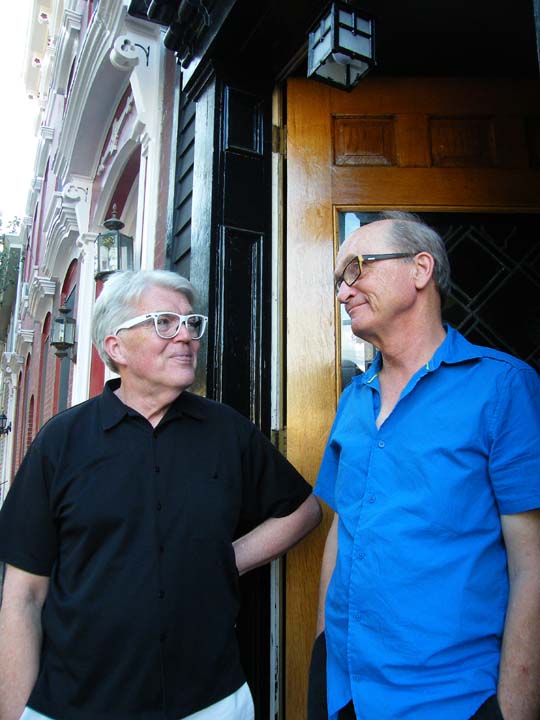
Tim Hare and Earl Ball, with Fluffy,
in the front parlor of Ravenwood,
talking about the work that has been
put into their antique
townhouse's restoration

Earl Ball shows off the woodwork on
the home's fireplace, in what was originally
the house's kitchen.
“We came in with snow shovels every weekend and shoveled it out,” Ball said. “I could see the potential though, even though there was no glass in the windows, and the wood was hatcheted.”

Getting to the point where they could even move in took a couple of years of steady hard labor, they said.

The plumbing and electrical wiring were not only outdated, but essentially destroyed from the many years of vacancy and neglect the property had suffered. So it all had to be replaced.

And, even when they finally moved in, the house was still a constantly ongoing project.

Earl Ball holds a photo, shown below,
of  how the room he's standing in
appeared , in the mid- to late
1980s before work on the house
was complete.
 Many rooms had pink walls over layers of wallpaper, and in others the plaster was badly damaged. The townhouse's original clapboard had been covered over with tar-paper with a faux-brick pattern at some point, which all had to be removed and the staple holes in the wood filled prior to the exterior being painted.

Ball spent countless hours and days, meticulously working room by room personnally to restore details in the wood trim that had been hacked and damaged and fixing damaged plaster work, as well as painting the exterior himself, twice now in the time the couple has lived there.

The process has taken many years to complete.

“I enjoy the process of restoring (old things) and bringing it back,” he said of what many would label tedious tasks.

A number of the house's details had been removed during its decline, such as doors, and had to be replaced, however. Not willing to compromise the house's historical details, Hare scoured curbsides near old house cleanouts both in Easton and in Harrisburg where he was working at the time, and brought home architectural details appropriate to the house to be incorporated into the restoration.

 It saved a lot of money, Hare said, and was also in keeping with the couple's goal of revitalization and renewal for the antique home.

Today, 28 years after Ball and Hare started its restoration, Ravenwood may well be more grand than it was when it was originally built. The two have additionally added an enchanting garden, and bought the adjacent vacant lot, which they have also improved by cultivating more garden space.

Having tracked down its history, Hare said the house was built for Easton blacksmith and carriage maker Eli Oberly and his family, and probably completed in 1871. Oberly, he added, was prosperous but not a very rich man.

The "servants' staircase"
 
The main staircase
“So while this was a big house, it wan't a fancy house,” Hare said.

Still, the house has a plainer, second staircase for servants' use leading to the second floor in addition to the grander staircase off the foyer, and while converting the third floor attic space into an open floor plan, there was evidence this space was used at one time for servants' quarters, an indication Oberly was probably doing fairly well.

The attic space also yielded some bits of history that were preserved despite the house's near fatal decline prior to its restoration and hint at previous owners' lives.


A trunk hidden away in the attic servants' quarters contained clothes, including an apron, a late 19th century corset and bust enhancer.

A woolen cap, typically the type a workman or young boy would wear was also found by Ball in the walls, along with a stash of beer bottles from an old Easton brewery.


And, in the yard, bottle and pottery shards, along with the “prize” of finds—a belt shield from a Union soldier dating back to the Civil War.

Ball has carefully kept and preserved these and other artifacts he's found, labeling them along the way. They're part of the house and its history, he says. 


But while Ball and Hare happily live among the fruits of 28 years of patient, meticulous labor and still love the neighborhood, they both have recently retired and say it's nearing time to pass their historic home to the next generation.

“This house needs someone younger, a family, perhaps, to carry it forward into the future,” Hare said.

To that effect, an ad on the Manhattan Craigslist appeared last week, declaring their intention to sell to the right buyer. The adjacent garden lot they will keep for now, but intend to allow first-option rights to whoever purchases Ravenwood.

They intend to stay in Easton, they said too, adding that they're not sure where they will move, but it won't be College Hill.

“We like the diversity of this neighborhood,” they said. “So wherever it is, we're not giving that up.”


Ravenwood is only one of a near-countless number of unique, one-of-a-kind historic buildings in the City of Easton, and The Easton Eccentric would like to highlight more of them. Are you currently restoring one of the city's numerous architectural gems? Do you own a house or other building that you'd like to highlight? Or, perhaps there's a structure you feel deserves some attention so it can get the love it deserves to further the mission of revitalizing our city?

If so, please email us! Your suggestion could very well be next on our list!