Showing posts with label historic restoration. Show all posts

Tuesday, January 21, 2014

Gov. Wolf Building Gets Zoning Approval, Other Projects Postponed

By Christina Georgiou

The Governor Wolf Building on North Second Street is one step closer to
being renovated into more than 50 apartments after the project gained
the city zoning hearing board's approval Monday evening.

Plans to renovate the Governor Wolf Building on North Second Street into more than 50 one- and two-bedroom apartments were approved by Easton's Zoning Hearing Board Monday night, though five other scheduled hearings for various other projects were postponed until February due to the properties not being posted with the hearing date.

A tech glitch, compounded by a communication failure in the zoning office, resulted in the city not mailing hearing notices to property owners surrounding all six of the properties on Monday night's agenda, and consequently, the properties weren't posted notices of Monday evening's hearing date as well, said Zoning Administrator Cindy Cawley.

The lack of notice left the applicants facing the prospect of any approvals by the zoning hearing board might make Monday being appealed, noted board solicitor Robert Nitchkey.

Five of the proposed projects, which included an application to convert a row of garages on South Tenth Street into a delicatessen and small grocery store, will either be heard at a special zoning hearing board meeting to be held on Monday, February 3 or at the regular meeting on Monday, February 17.

Representatives for the Governor Wolf building, however, chose to go forward with their hearing, saying the agreement of sale to buy the property from Northampton County for $1.92 million is contingent on city zoning approval.

William Vogt, a principal partner of VM Management, which is purchasing the former Easton High School campus, said he'd talked with neighboring property owners and feels their concerns have been satisfied, making the chance of a substantial appeal unlikely.

The Penny Arch will be restored, VM Management partners
have promised.
Architect Lucienne Di Biase Dooley of Artefact, directing the project, echoed statements made by VM partner Mark Mulligan last week, telling zoning hearing board members the building's exterior will not be altered, and that plans include the application for historic preservation tax credits. She added that the group intends to restore the Penny Arch, currently in serious disrepair, and also the former school's bell tower.

Other features of the Governor Wolf building, including an interior spiral staircase and ornamental doors, will also be preserved, she added.

Neighboring property owner Charles Klabunde said he supports the preservation of the building, though he had some questions about the project.

"I think it's a good use," he told zoning board members. "It's not my first choice...(but) I appreaciate the consideration these people are giving this old building."

He added that he was concerned that construction vehicles might cause congestion on the street and inconvenience current residents during the renovation work.

Klabunde also suggested that the clock tower's bell be operated manually after its restoration, saying that the building's residents might not appreciate it ringing every hour through the night. He added the bell could be rung for special occasions, such as on Independence Day.

"It's really worth saving," Klabunde said. "It's the only really big bell we have left, and we ought to maintain it."

Dooley said that construction vehicles will mostly access the building from the rear through the parking lot on Larry Holmes Drive and that traffic along North Second Street won't be affected by the project.

"Historic renovation is what we specialize in," said Vogt. "We're sensitive to the neighborhood. We've done projects like this before. We're looking forward to bringing this building back."

Zoning hearing board members, along with city staff, said they support the project, and noted the variances it requires--including relief from a requirement that the first floor be used for commercial space--largely stem from the nature of the historic building's situation.

"I really think this is a good reuse of an existing building," Cawley said. "They're providing all the parking that's required, and I recommend it."

"Regarding the retail space, they're right. It's too far back," said board chairman Michael Civitella.

Vogt said the board's approval is the last step in ensuring the project will go ahead, and that he expects the agreement of sale with Northampton County to be executed and the property officially transferred to VM Management ownership soon.

It has been previously estimated the project will be complete and the apartments occupied by new residents by the end of 2015.

'We're making a big investment here," Vogt said. "We want everything to work for everyone in the city."

Wednesday, May 15, 2013

Easton Honors Individuals, Businesses for Perseverance

By Christina Georgiou

About 125 people, all long-time Easton residents and business owners, gathered at the Sigal Museum Tuesday evening for an awards ceremony held by the city to honor those that have aided in the economic and cultural successes the urban area is currently enjoying.

Easton Mayor Sal Panto, emcee of the event, praised the efforts and drive of the award recipients, which included 56 businesses and 27 individuals, noting they persevered when the city was suffering from blight and suburban flight.

"We are ever so fortunate to celebrate the many new businesses and restaurants coming to our city, and we should celebrate their arrival.  However, tonight we are here to honor those that stayed, those businesses that have made Easton their home for more than 20 years.  Tonight we honor those businesses and individuals who have seen the best times and, unfortunately, the worst of times, for our city.

"To the individuals who stayed, and to the individuals that stopped the demolition, we wish we could give you more than a certificate, but know that we deeply appreciate what you all have done for Easton," Panto added.

Panto said the drive to save Easton from the devastating effects of the federal government's "urban renewal" projects was not universal, and many gave up, but those that didn't are responsible for the preservation of numerous city landmarks that residents and visitors enjoy so much today, such as the State Theatre and the Bachman Publick House.

"There were Hollywood companies that wanted to take (the State Theatre) apart piece by piece, because it really is beautiful," he said. "But the amazing thing is, it wasn't the most beautiful theater in Easton. There were seven others."

The others were all destroyed during the urban renewal period, but involved, concerned citizens managed to buy the State Theatre for $25,000, form a non-profit group, and eventually restore it, he said.

Antonia Mitman talks about
her efforts, with others, to
stop the demolition of the
State Theatre and other
buildings in Easton.
"No one thought we could do it," he said. "It was a time of conflict and disagreement.  It was a time when Easton was trying to react to the flight to the suburbs by trying, although unsuccessfully, to turn itself into a suburb."

Antonia Mitman, who was part of the group that worked toward that goal, said she got involved after her mother, tired of hearing her complain what was going on, told her to do something about it.

"It wasn't the most popular thing," she said, adding that Easton's success in fighting urban renewal and its effects is an anomaly. "Stories like this are uncommon. There are so many cities in America that are dying on the vine."


Timothy Hare, received special recognition Tuesday evening
for his efforts towards preserving historic buildings in Easton,
including the Quadrant.
Architect Timothy Hare, also honored last evening, who worked to save the Quadrant and other Easton buildings from the wrecking ball, said he did it because although he was a newcomer at the time, he felt the city was beautiful and unique, and didn't want to see it destroyed.

"I saw Easton the way it could be," he said.


Easton Longevity Award recipients:
(for businesses in the city for 20 years or longer)
  • Wolper Subscriptions, 20 years
  • Connexions, 23 years
  • Marie’s Dance Studio,  25 years
  • Antonio’s, 26 years
  • Panche, 26 years
  • The Strand, 28 years
  • American Printing Unlimited, 29 years
  • 42 North Second Street, 30 years
  • W-Graphics, 30 years
  • Mother’s, 30 years
  • Josie’s New York Deli, 31 years
  • Aura Ceramics, 32 years
  • Joe Parsons
  • Investment Advisors Management, 35 years
  • Quadrant Books, 35 years
  • Elliott and Elliott, 35 years
  • Wawa, 36 years
  • McDonald’s, 36 years
  • Nature’s Way, 38 years
  • Lafayette Bar and Hotel, 38 years
  • Genesis Bikes, 39 years
  • Angelo’s Restaurant, 40 years
  • EPA Title Company, 40 years
  • Lewis and Walters, 42 years
  • Utopia, 44 years
  • Industrial Communications, 47 years
  • White Singer Sewing, 50 years
  • Leo’s Barber Shop, 52 years
  • Monarch Furniture, 61 years
  • New York Tailor, 61 years
  • Joe’s Market and Deli, 62 years
  • Colonial Pizza, 65 years
  • Jack n’ Jill Studio, 66 years
  • Easton CafĂ©, 68 years
  • The London Shop, 74 years
  • Emmanuel Travel, 78 years
  • Luco’s, 78 years
    Members of the Bassil family, owners of the Carmelcorn Shop, pose for a
    photo with Easton Mayor Sal Panto, after receiving recognition for the
    shop's longevity.
    
  • Carmelcorn Shop, 82 years
  • Easton Upholstery, 87 years
  • Kaplan’s Awnings, 90 years
  • Kressler Wolff and Miller, 90 years
  • Lauter’s Furniture, 98 years
  • Halpin’s Garage, 99 years
  • Prudential Paul Ford Realtors, 100 years
  • Herster, Newton and Murphy, 110 years
  • The Express-Times, 158 years

Easton Award recipients:

(for preservation of The Bachman Publick House)
  • Robert Butow
  • Nancy Summerill Butow
  • James J. Chester
  • Marianina Savoia
  • Bob and Karen Doerr  (and Phoenix Fire House restoration)

(for preservation of The State Theatre)
  • Richard Wolff
  • Ken Klabunde
  • Charlie Smith
  • Gail Brogan
  • Andy Daub
  • Lee Grifo
  • Nancy Sanquist
  • Pat Marhefka  (deceased)
  • Dick Cornish  (deceased
  • Antonia Mitman

Honored for their participation in the "Historic Easton Movement":
("The rebels of the 80s")
  • Dale Falcinelli
  • Mary Koch
  • Steve Glickman
  • Paul Felder
  • Jeff Gilbert
  • Oliver Andes
  • Karl Stirner
  • John Cappellano
  • Bryant Matyger
Special recognition:
  • Timothy George Hare
  • Former Mayor Phil Mitman

Thursday, May 9, 2013

Nevin Park to Finally Get Fountain Restored

By Christina Georgiou

The fountain in Nevin Park, as it appeared about 100 years ago. It was
dismantled for maintenance in the 1920s, which never happened. The
iron fountain was later melted down for scrap during World War II.
A long-time plan to replace the pile of rocks that sits at the center of Nevin Park in Easton's College Hill neighborhood with a fountain reminiscent of the one that formerly graced the park is finally coming to fruition, and it will include the expansion of the Karl Stirner Arts Trail as well, it was announced at Wednesday evening's city council meeting.

The pile of rocks that sits today where the old fountain
used to be in
College Hill's Nevin Park.

It's been about 90 years since Nevin Park's fountain, originally erected in Downtown Easton's Centre Square in the 1860s as a celebration of clean water and moved to the park in 1899 to make way for the Soldiers' and Sailors' Civil War monument, disappeared. Historic record says it was dismantled for maintenance in the 1920s, but the repairs never happened. Instead, it was melted down for scrap during World War II.

Residents have long lamented the antique fountain's loss, but a similar fountain of the same style will soon grace the park, thanks to the efforts of a committee of dedicated citizens.

CHNA president Hubert
Etchison outlines the
Nevin Park fountain
plan to Easton City Council
members Wednesday
evening.
 Hubert Etchison, president of the College Hill Neighborhood Association, which spearheaded the effort, presented a plan to Easton City Council Wednesday evening outlining the plan.

The group considered both a custom-made restoration of the original fountain and the purchase of a ready-made piece. A low bid for a recreation of the original fountain came in for $367,500, which was far beyond the amount the group budgeted for the project.

"It would take a lot of yard sales to get there," Etchison said. "Unless someone wants to write us a check..."

However, the committee chanced upon an opportunity to buy a ready-made fountain, identical to one currently erected in Marietta, Georgia, for $37,500, Etchison said.

"The restoration of the fountain area in Nevin Park will provide a focal point for activity along the Karl Stirner Arts Trail, provide an adult-friendly vista, and aid in enhancing the economic growth of College Hill through increased traffic to its key business corridor" he said. "This vision and plan will highlight key historical aspects of Nevin Park and College Hill that might otherwise be lost."

The fountain the CHNA committee intends to purchase, as seen in its current
location in Marietta, Georgia.
The expansion of the trail will include new historic markers outlining the stories of key events in Easton's history. The marker project may include an audio project that could be completed by local middle- and high school students and would be playable on smartphones, Etchison said.

The graceful beauty of the fountain will add aesthetic appeal to the park, and also provide photographic opportunities at the park for things like weddings, Etchison said.

The walking trail would be extended from the base of College Hill on North Third Street up the hill and have two paths, one for "strong walkers" and another, longer route that would accomodate more leisurely paces.

The group has raised nearly $22,000 toward the effort, which in its entirety is expected to cost about $205,000

The city earmarked $75,000 in its capital improvements fund two years ago, Mayor Sal Panto said, with an agreement that the city would match citizens' fundraising efforts 2 to 1 and release the funds when the goal was realized.

About $31,000 in demolition, site prep work, and the preliminary utility installation work has been secured as in-kind donations, Etchison said.

The group hopes to secure $90,000 in grant funding, and will cover the estimated remaining $18,300 through further fundraising efforts, he added.

A map of the proposed extension through College Hill of the Karl Stirner
Arts Trail.

As part of the plan, the group also intends to create a refurbishment fund to cover the costs of future maintenance, expected to be needed about 25 years after the fountain's installation, to ensure it is properly kept in good working order for future generations.

The funds raised and pledged so far are enough for the CHNA committee to commit to buying the Marietta fountain and get the ball rolling, hopefully by July 1 of this year, Etchison said.

Getting to the point of seeing the fountain completely installed will likely take about a year. New piping and electrical lines need to be run in the area, and the pad needs to be replaced, he noted.

Marietta has been helpful too in providing advice for the future preservation of the fountain, Etchison said. Unlike the installation in Georgia, in Easton it will likely have a granite pool rim, which will help keep the fountain's iron in good condition, he said.

The extension plans for the Karl Stirner Arts Trail will likely take at least two years, said Easton Planning Director Becky Bradley.

To effect that change, the city's comprehensive plan, currently undergoing an update, will need to be modified, and the regional greenway plan will need to be updated as well, both processes that take time.

Additionally, some funds will likely need to be raised in addition to those already budgeted for, she said.

"Their vision is great," she said, enthusiastic about the plan.

Other officials were also very upbeat about the park upgrade and citizen involvement in extending the walking trail through the city.

"(The fountain) is one of the few things we can do for College Hill because they're not eligible for grant dollars," Panto said. "We're 100 percent on board at the administration."

Councilman Jeff Warren also praised the plan.

"This is truly a visionary project for College Hill," he said, noting that the pile of rocks currently in the fountain's place is one of his first memories of the city. "Believe me, I'll be happy to see it go, but it does hold some fond memories for me."

Etchison credited committee members for their persistance and dedication to the effort.

"There's no way we would have gotten here without our volunteers," he said.


An old photo of the original fountain, as seen in Easton's Centre Square, before it was moved to Nevin Park in 1899 to make way for the Soldiers' and Sailors' monument, which still stands in its place today.


Tuesday, September 4, 2012

Ravenwood: A West Ward Tale of Love and Labor

By Christina Georgiou

Ravenwood, as it is today, off the corner of Ferry and
Walnut streets in Easton's West Ward, is the result
 of a lot of labor...and love.
If you're familiar with the Easton's West Ward, you've probably noticed “Ravenwood”, that rather stately townhouse the oozes yesteryear charm just off the corner of Ferry and Walnut streets, in what was once one of the city's poshest neighborhoods.

And, if you're not a life long city resident, it's easy to believe that this beautiful home has always been this way. However, that is not so.

While originally built in Easton's late 19th century heyday, Ravenwood's amazing old world charm and beauty is actually more of a survivor's tale, and the building's story in the past 30 years reminiscent of that of a phoenix rising from the ashes after near destruction.

For nearly destroyed it was. In the early 1980s, Easton was still reeling from the effects of the federal “urban renewal” projects that swept America following World War II, reaching culmination in the 1960s and '70s.

The concentrated federal pressure to declare city neighborhoods “blighted”, even thriving ones like Easton's Downtown commercial district, drove much of the urban middle- and upper-class out to suburban developments, leaving the surrounding neighborhoods to suffer from severe economic and social decline.


Earl Ball in front of Ravenwood, in the mid 1980s.
Faux brick tar paper covered the exterior clapboard,
windows were missing glass, the electrical and plumbing
systems needed complete replacement, and rooms
were strewn with trash when architect
Timothy Hare purchased the property. Below, the house
is shown as it continues to undergo renovation,
more than a year later.
  In 1984, when current owners Earl Ball, a minister, and Timothy Hare, a certified architect, came upon Ravenwood, it was in an utterly dismal state of genuine blight and disrepair. A friend had pointed out the property, up for sale for a low five-digit sum. But even at that price, and compared to the sky-high prices in New York City, the couple hesitated, rife with doubts about the work involved to make the property liveable.

“It was condemned,” Hare said. “So you couldn't get a mortgage or fire insurance for it.”

Earl Ball in the 1980s, removing
trash from Ravenwood's yard.
“Every room was filled with garbage,” Ball said.

“The yard was even worse,” Hare said. “There were just mountains of garbage and debris.”

The surrounding homes were not any  better off. Revitalization in Easton was barely in its infancy, and a row of nearby abandoned vacant homes was being auctioned off by the city for paltry four-digit sums under the “Old Homes” program of the time.

In the early 1980s, Ball and Hare were living in the Village in Manhattan but had met at Easton's first Heritage Day celebration in 1976. They fell in love at first sight, both agree, and they have been partners ever since—legally married in the several states that allow it, as well as in Canada.


Living in New York was losing its appeal, but neither saw the suburbs as an ideal haven. So despite a number of reservations about the property, Hare took the plunge and bought it.

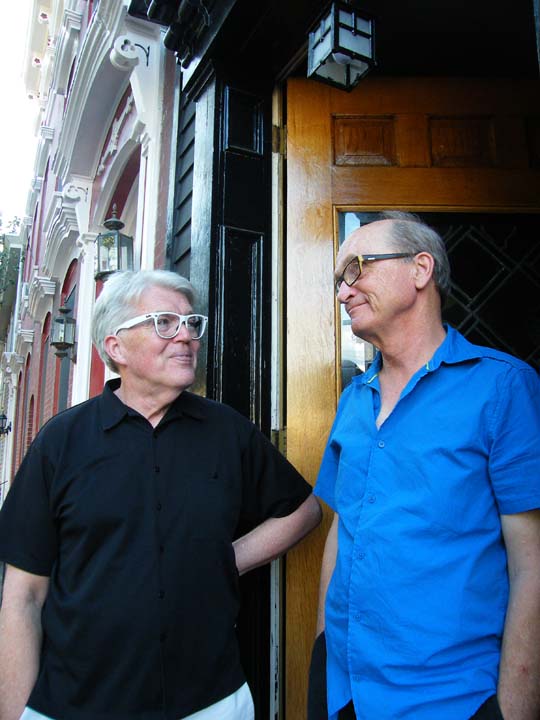
Tim Hare and Earl Ball, with Fluffy,
in the front parlor of Ravenwood,
talking about the work that has been
put into their antique
townhouse's restoration

Earl Ball shows off the woodwork on
the home's fireplace, in what was originally
the house's kitchen.
“We came in with snow shovels every weekend and shoveled it out,” Ball said. “I could see the potential though, even though there was no glass in the windows, and the wood was hatcheted.”

Getting to the point where they could even move in took a couple of years of steady hard labor, they said.

The plumbing and electrical wiring were not only outdated, but essentially destroyed from the many years of vacancy and neglect the property had suffered. So it all had to be replaced.

And, even when they finally moved in, the house was still a constantly ongoing project.

Earl Ball holds a photo, shown below,
of  how the room he's standing in
appeared , in the mid- to late
1980s before work on the house
was complete.
 Many rooms had pink walls over layers of wallpaper, and in others the plaster was badly damaged. The townhouse's original clapboard had been covered over with tar-paper with a faux-brick pattern at some point, which all had to be removed and the staple holes in the wood filled prior to the exterior being painted.

Ball spent countless hours and days, meticulously working room by room personnally to restore details in the wood trim that had been hacked and damaged and fixing damaged plaster work, as well as painting the exterior himself, twice now in the time the couple has lived there.

The process has taken many years to complete.

“I enjoy the process of restoring (old things) and bringing it back,” he said of what many would label tedious tasks.

A number of the house's details had been removed during its decline, such as doors, and had to be replaced, however. Not willing to compromise the house's historical details, Hare scoured curbsides near old house cleanouts both in Easton and in Harrisburg where he was working at the time, and brought home architectural details appropriate to the house to be incorporated into the restoration.

 It saved a lot of money, Hare said, and was also in keeping with the couple's goal of revitalization and renewal for the antique home.

Today, 28 years after Ball and Hare started its restoration, Ravenwood may well be more grand than it was when it was originally built. The two have additionally added an enchanting garden, and bought the adjacent vacant lot, which they have also improved by cultivating more garden space.

Having tracked down its history, Hare said the house was built for Easton blacksmith and carriage maker Eli Oberly and his family, and probably completed in 1871. Oberly, he added, was prosperous but not a very rich man.

The "servants' staircase"
 
The main staircase
“So while this was a big house, it wan't a fancy house,” Hare said.

Still, the house has a plainer, second staircase for servants' use leading to the second floor in addition to the grander staircase off the foyer, and while converting the third floor attic space into an open floor plan, there was evidence this space was used at one time for servants' quarters, an indication Oberly was probably doing fairly well.

The attic space also yielded some bits of history that were preserved despite the house's near fatal decline prior to its restoration and hint at previous owners' lives.


A trunk hidden away in the attic servants' quarters contained clothes, including an apron, a late 19th century corset and bust enhancer.

A woolen cap, typically the type a workman or young boy would wear was also found by Ball in the walls, along with a stash of beer bottles from an old Easton brewery.


And, in the yard, bottle and pottery shards, along with the “prize” of finds—a belt shield from a Union soldier dating back to the Civil War.

Ball has carefully kept and preserved these and other artifacts he's found, labeling them along the way. They're part of the house and its history, he says. 


But while Ball and Hare happily live among the fruits of 28 years of patient, meticulous labor and still love the neighborhood, they both have recently retired and say it's nearing time to pass their historic home to the next generation.

“This house needs someone younger, a family, perhaps, to carry it forward into the future,” Hare said.

To that effect, an ad on the Manhattan Craigslist appeared last week, declaring their intention to sell to the right buyer. The adjacent garden lot they will keep for now, but intend to allow first-option rights to whoever purchases Ravenwood.

They intend to stay in Easton, they said too, adding that they're not sure where they will move, but it won't be College Hill.

“We like the diversity of this neighborhood,” they said. “So wherever it is, we're not giving that up.”


Ravenwood is only one of a near-countless number of unique, one-of-a-kind historic buildings in the City of Easton, and The Easton Eccentric would like to highlight more of them. Are you currently restoring one of the city's numerous architectural gems? Do you own a house or other building that you'd like to highlight? Or, perhaps there's a structure you feel deserves some attention so it can get the love it deserves to further the mission of revitalizing our city?

If so, please email us! Your suggestion could very well be next on our list!